How to Choose the Right Aluminum Foil Container Size for Your Restaurant
Why Container Size Directly Impacts Your Bottom Line
Walk into any commercial kitchen during prep hours and you'll see a common mistake: containers that are either half-empty or overflowing. Both scenarios cost money. An oversized 1000ml container for a 400ml entrée means you're paying for aluminum you don't need. An undersized 250ml cup for a 500ml pasta portion creates mess, customer complaints, and potential food safety issues.
At AILVBO, we've manufactured over 200 million aluminum foil containers for restaurants across 60 countries. The data is clear: restaurants that standardize their container sizes reduce packaging costs by 15–22% within the first quarter.
The Standard Size Breakdown
Small Containers (100ml – 350ml)
Best for: Side dishes, sauces, condiments, dessert portions, children's meals
A 125ml round container holds approximately 4.2 fluid ounces — ideal for a side of ranch dressing or a single serving of fruit compote. The 250ml rectangular option works well for coleslaw, potato salad, or rice side dishes.
Real-world tip: A fast-casual chain in Texas switched from generic 200ml containers to standardized 150ml sauce cups and 300ml side containers. Their annual packaging spend dropped $14,300 while customer satisfaction scores for "proper portioning" increased 8%.
Medium Containers (400ml – 750ml)
Best for: Standard entrées, lunch specials, meal prep single servings
The 500ml rectangular container (approximately 6.7″ × 4.7″ × 1.6″) is the workhorse of the restaurant industry. It comfortably fits a standard protein + starch + vegetable configuration without overflow or excessive headspace.
For pasta-focused menus, the 600–750ml range provides the extra volume needed for sauce displacement. A 650ml oval container works exceptionally well for lasagna, baked ziti, or pasta primavera — the elongated shape matches the natural geometry of long pasta dishes.
Large Containers (800ml – 1500ml)
Best for: Family-style portions, catering trays, combo meals, bulk storage
The 1000ml rectangular container serves 2–3 adults comfortably. For catering applications, the 1500ml option handles party-sized portions of baked dishes, roasted meats, or rice-based entrées for 4–6 people.
Critical consideration: Large containers require matching lids. A 1000ml container with a 950ml-rated lid creates a gap that leads to spillage during transport. Always verify lid-container compatibility before placing bulk orders.
Matching Container Shape to Menu Item
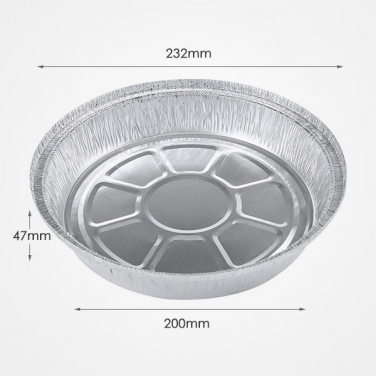
Round Containers (100ml – 2000ml)
Round containers distribute heat most evenly during oven reheating, making them ideal for:
- Pies and quiches (even crust browning)
- Soups and stews (no cold spots)
- Single-serve casseroles
- Round baked goods (muffins, individual cakes)
Rectangular Containers (250ml – 2500ml)
Rectangular containers offer the best space efficiency for storage, transport, and display:
- Stack 30% more efficiently than round equivalents in delivery bags
- Fit standard meal prep containers and refrigerator shelving
- Maximize oven rack space during batch reheating
- Present well in rectangular chafing dishes
Oval Containers (500ml – 2500ml)
Oval containers serve a specific niche: whole fish, roasted poultry, and large meat cuts. The elongated shape accommodates the natural form of these proteins without excess empty space that leads to sauce pooling and uneven heating.
A 1200ml oval container fits a whole roasted chicken (approximately 1.2–1.5kg) with minimal headspace, preserving moisture and preventing the "steam bath" effect that makes skin soggy.
The Lid Compatibility Matrix
Container size selection is incomplete without considering lid options. Here's what works:
| Container Type | Standard Aluminum Lid | Cardboard Lid | Plastic Dome Lid | |---|---|---|---| | Round 100–500ml | Crimp seal, oven-safe | Printable, economical | Clear PET visibility | | Rectangular 250–1000ml | Full-seam crimp | Custom branding surface | Not available | | Rectangular 1000ml+ | Reinforced crimp | Structural support | Limited availability | | Oval 500–1500ml | Custom-fit crimp | Not recommended | Not available |
Important: Cardboard lids cannot withstand oven temperatures above 180°C (356°F). If your workflow involves oven-to-table service with covered containers, specify aluminum lids.
Calculating the Right Size: A Practical Formula
Use this approach when evaluating a new container size:
1. Measure your standard portion in milliliters (fill a measuring cup to your typical serving level) 2. Add 15–20% headspace for sauce, toppings, and safe handling 3. Round up to the nearest standard size in our catalog
Example: Your kitchen serves 450ml of curry rice per order.
- Base portion: 450ml
- With 18% headspace: 531ml
- Nearest standard: 550ml or 600ml rectangular container
Cost Analysis: Size Standardization vs. Mixed Inventory
Operating with 3–4 container sizes instead of 8–10 creates measurable savings:
| Cost Factor | Mixed Inventory (8+ sizes) | Standardized (3–4 sizes) | |---|---|---| | Storage space | High (multiple SKUs) | Low (consolidated) | | Order minimums | Higher per SKU | Lower, volume discounts | | Inventory tracking | Complex | Simple | | Staff training | Extensive | Minimal | | Waste from wrong-size selection | 5–8% | <1% |
A mid-size catering operation in Chicago reduced their active container SKUs from 12 to 4. Their annual packaging cost decreased $31,400, and kitchen staff reported 40% faster prep times due to eliminating size-decision delays.
Temperature and Material Considerations
All AILVBO containers are manufactured from food-grade 3003 or 8011 aluminum alloy, rated for oven use up to 260°C (500°F). However, size affects thermal performance:
- Small containers (under 350ml): Heat rapidly, risk of overcooking. Reduce reheat time by 15–20%.
- Medium containers (400–750ml): Standard reheat profiles apply. Most predictable performance.
- Large containers (800ml+): Require 25–30% longer reheat times. Consider venting the lid to prevent pressure buildup.
Ordering Samples Before Committing
Never select container sizes based on catalog dimensions alone. Request physical samples and test with your actual menu items:
1. Fill with hot food and seal with the intended lid 2. Transport in your standard delivery bag or catering crate 3. Reheat in your standard oven profile 4. Serve and evaluate presentation 5. Check for leaks, sagging, or lid failure
AILVBO provides free samples for evaluation. Contact our team at fliany365@gmail.com or WhatsApp +86 15810953132 with your menu specifications, and we'll recommend 3–4 container sizes that match your operational needs.
Conclusion
The right container size isn't a packaging detail — it's a operational decision that affects food quality, customer satisfaction, and profit margins. Start with 3–4 standardized sizes that cover 90% of your menu, verify with physical samples, and adjust based on real kitchen feedback.
For restaurants building or refreshing their packaging program, the 500ml rectangular container, 250ml rectangular side dish, and 1000ml rectangular family size handle most use cases effectively. Add specialty shapes (round for baked goods, oval for whole proteins) only when the menu specifically demands them.